
Would I Rather Look Like a Weird Old Lady or Fall on My Face?
Sometimes independence requires a little embarrassment

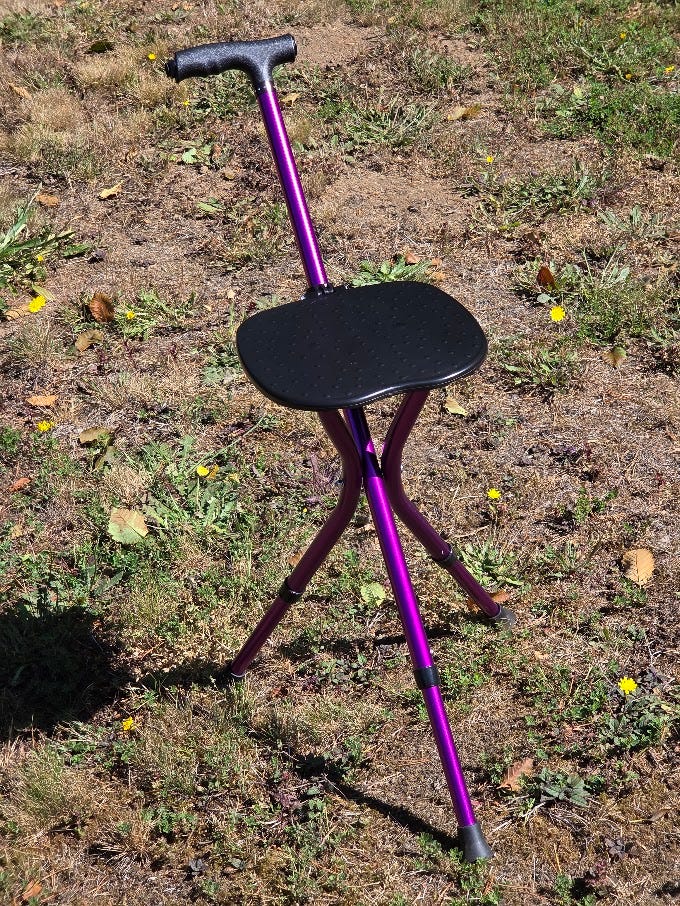
I bought something unusual for myself last week: a purple walking cane with a seat and two extra legs so I could walk farther and rest along the way. The occupational therapist at the hospital had recommended a walker with a seat, but my legs still work.
As I heal from pericarditis, an inflammation of the lining around my heart, I’m back to my daily walks, but sometimes I need to sit and rest. There aren’t a lot of benches in the forest.
In the past, when I walked my old dog, if I was desperate for a break, I just sat in the dirt, but there are spiders and ticks down there. Plus, I worry that passersby might think I have fallen and call 911.
The cane needed to be assembled, and the instructions might as well have been in another language, but once you’ve put together a few walkers, commodes and canes, they all work pretty much the same. Slide here, click here, tighten here.
I got the legs spread out and the small seat flipped down and slowly eased into a sitting position facing the cane. Perfect.
The hard part, I soon discovered, was taking my new toy out into the world. I was embarrassed. I would look like a weirdo sitting on the side of the road on this tiny chair with a cane handle sticking up.
I tried it in the backyard first. My ground is an uneven mix of grass, weeds, dandelions, and rocks. The cane worked great. I’d walk a bit, sit, walk again, sit. It wouldn’t work in the sand; I’d need to be on solid earth or pavement, but I loved my new cane/chair.
Still, did I want the neighbors to see me using it? Maybe I should take it to a deserted trail somewhere.
But I didn’t. I was still having chest pains and decided to stay home. I finally took my cane on my usual walk on Saturday. It scared the dog at the end of the street. I left it against a fence and walked up to comfort her before moving on.
Walk, chunk, walk, chunk. I got into a rhythm. I thought I’d sit by the pond around the corner, but there was no flat spot off the road, so I parked myself farther down by the two trees growing out of one trunk.
Ah, rest. Could anybody see me? I heard a car coming my way. I folded my chair and walked on.
Where a trail leads off to the south, I sat again. Not bad.
OMG. From the east, a group of adults, children and dogs came walking up the hill. They all saw me.
Look at that weird old lady sitting on that purple thing.
If I had any guts, I’d have just sat there and waited for them to come to me. I’d let them ask questions and show them how the chair worked. Instead, I stood, folded my cane/chair and headed west toward home, carrying the damned thing.
Sunday night, I walked without my cane/chair. The good news: I made it through most of my normal walk at full speed with no chest pain or gasping for breath. The bad news: my knee locked up halfway home, as it does from time to time. Looking down the long stretch of road ahead of me, I wished I had my purple cane/chair.
Accepting that you might need help even if it looks odd is a challenge. It might be easier away from home where no one knows you.
On vacation back in 1989, I broke my foot in Grants Pass, Oregon. I couldn’t put any weight on it. I left the local hospital on crutches. Forget the hikes we had planned. Luckily, I had my husband to manage everything while I sat with my foot in the air. I didn’t worry about embarrassment or people I knew asking, “What did you do?” Nobody in Oregon knew me. I also had the comfort of knowing this was just a temporary thing.
I have had numerous foot and ankle injuries. The last time, I sprained my ankle when I missed a step at a local restaurant. (Go ahead; call me a klutz.) After another visit to the hospital, I was back on crutches, but I was older and couldn’t handle them nearly as well as I did before. As I struggled to cook, dress, and do all the things I needed to do, I frequently lost my balance and pitched onto the nearest chair, sofa, or counter. At times, I got on the floor and crawled. It was safer.
I did have some help. A friend hauled in 40-pound bags of pellets for the pellet stove that heated my house at the time. My pet sitter walked the dog. But I was mostly alone. I should have asked for more help, but that was a long time ago–2012?—and I probably didn’t think I had anyone I could call. Plus, I was embarrassed that I had hurt myself that way.
When I showed up at church on crutches, people asked questions. If anyone offered help, I probably said I was fine.
Fourteen years later, I’m better about asking for what I need.
If/when I sprain my ankle or otherwise hurt my feet again, I will insist on getting one of those scooters I see other people using. There will be no hiding it, but at 74, I’m not safe on crutches. Worst case, I have my husband’s wheelchair in the garage.
I need to get over myself. I might not need a cane all the time now, just some mornings when everything hurts, but sometime in the future, a cane might become my permanent companion. If I show up with a new piece of equipment, be it a cane, walker, or wheelchair, someone is going to ask, “What did you do?” Others will just stare. Will they see a person who is handicapped instead of fit and active? Will they see an old woman?
It doesn’t matter, especially when it feels so good to sit when your body needs a rest. Some people might think I need help. Sometimes they might be right. If they offer, I should graciously say, “Thank you” and let them help me.
Or maybe I should let them try my tiny chair and dance a few steps to show them I’m still kicking.
What does this have to do with living alone? The right equipment can help us manage our solo lives on our own instead of depending on other people. If I were still too weak to stand in the shower, for example, I could unbox the shower chair I bought two months ago and sit while I wash myself. There’s no shame in it.
Yes, the time might come when it is not safe to live alone, but for now, we can make adjustments. Instead of being embarrassed, we should feel proud.
This article from Walkingcanes.com, “How to Feel Confident Using a Cane in Public,” offers some terrific advice if you’re self-conscious about using a walking aid.
I like this quote: “Without it, you might have stayed home. You might have skipped the family dinner, the grocery run, the evening walk. The cane isn’t the thing limiting your life — it’s the thing making your life possible. It’s not a symbol of what you’ve lost. It’s a tool for what you’re still doing.”
Did I mention my new cane is purple?
(FYI, I bought my “BigAlex” cane with folding seat on Amazon for $41.99.)
Let’s Talk
Have you had to make adaptations to an injury or illness that made you self-conscious about how you look to the world? Have you been injured and refused to ask for help or gear that would make it easier?
More to Read
“My Decision to Start Using a Cane in Public,” by Steven Paul for https://themighty.com.
Interesting discussion on Reddit about using a cane
Saturday’s Zoom discussion with Jodi Sh. Doff about caregiving for our parents went well, although I suspect some people had trouble with the links and couldn’t get in. I’m sorry if that happened to you.
The recording is online now. Watch it here. I was the featured speaker, but we left plenty of time for discussion, and we all had a lot to say. Difficult parents, resentment, expenses, finding reliable help, the horrors of nursing homes, assisted suicide—we discussed it all.
Taking care of a loved one with a long-term illness may be the hardest thing any of us ever do, and we need to talk about it.
How did I end up alone? My first marriage ended in divorce. My second husband died of Alzheimer’s disease after we had moved to the Oregon coast, far from family. I never had any kids, only dogs and cats. Now I live by myself in a big house in the woods. You can read our story in my memoir, No Way Out of This: Loving a Partner with Alzheimer’s, available at your favorite bookseller.
Here's an alternative framing when someone offers to help. (I experienced this as a random act of kindness on the SF Bart train this past year when a younger person offered me a seat on a crowded train. I wasn't even carrying anything, injured, or tired. I could have taken offense and refused the offer, as we stubborn Americans often do.)
I said "Yes, thank you! How very kind of you." and sat. This made me sound like I was 104, not 67 and fit. But here's the point: I was reinforcing the social herd gesture (in a younger member) of being compassionate, noticing another person, and respecting an elder. In other words, accepting help is not weakness on your part; it's an act of teaching. We are the matriarch elephants helping the younger ones learn the ropes of survival. So go forth and be the teacher/mentor!
How timely! Just found a CAP (certified aging in place) occupational therapist on Instagram. It’s called inhomelivingllc. She’s currently helping her mom with devices and methods to live independently after a bad fall, but I think she does this all the time for her regular clients. I’ve picked up some really helpful tips on things like bathing chairs, walker trays etc for my brother who’s recovering from a fall - damaged shoulder and hip. She also has decent suggestions if you’re doing any remodeling so you can age in place. That’s my goal!